






"The Chieng So Tower was built around the 15th-16th centuries, located in Na Muong village, Chieng So commune, Dien Bien Dong district (now Muong Luan commune), Dien Bien province. The name Chieng So Tower comes from the local people's long-standing tradition; in reality, the tower is also called "Chieng So" because "chieng" means New Year's. The Chieng So Tower is classified as an architectural and artistic relic, reflecting the cultural and religious characteristics of the Lao people in Northwest Vietnam in general and Dien Bien province in particular.
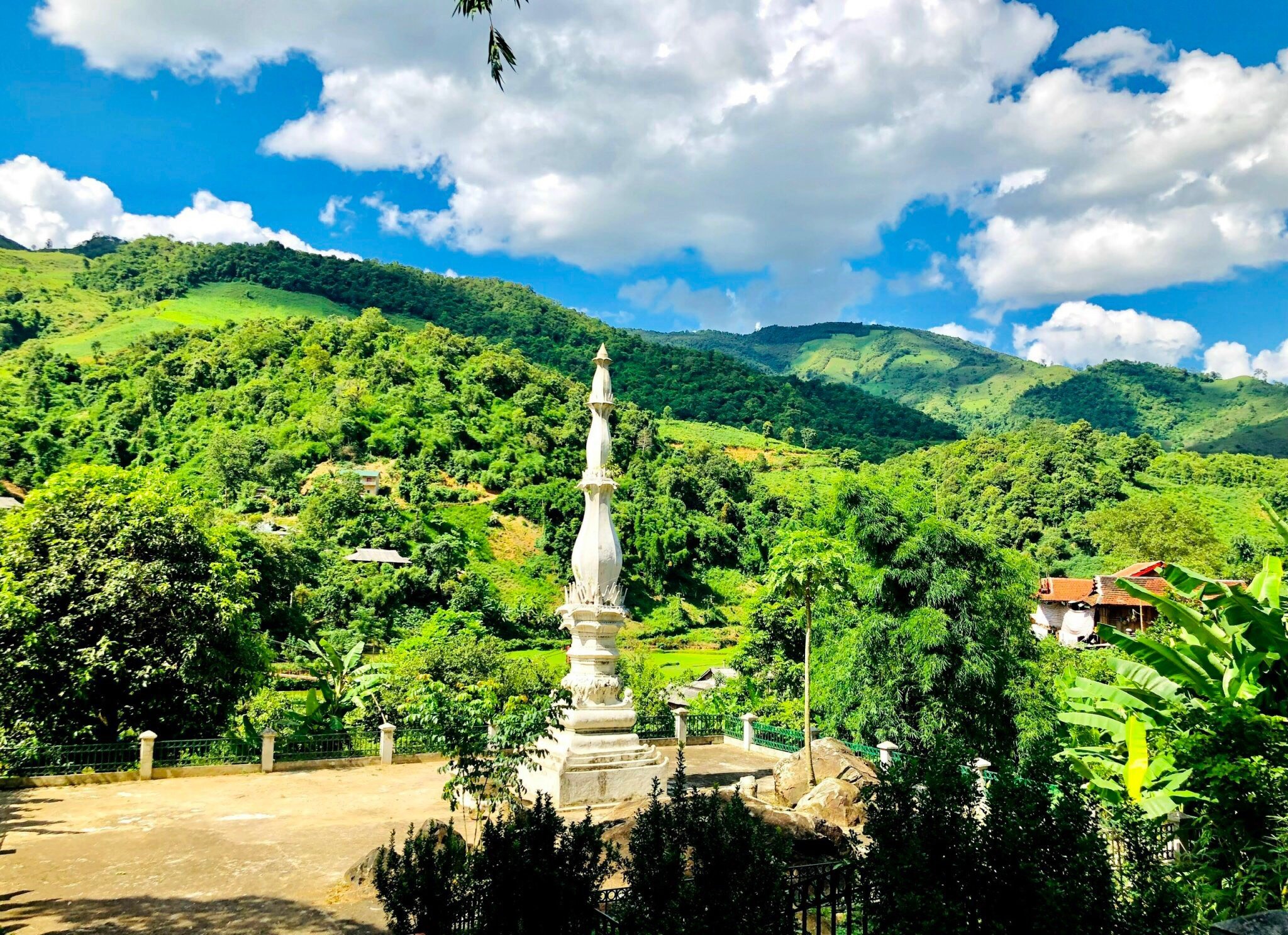
The Chieng So Tower is situated on a beautiful piece of land with picturesque scenery, resembling a person standing with their head facing Vietnam and their back facing Laos. Therefore, the people of Chieng So often say, "Hua tang Keo, co tang Lao." The tower was built using bricks, lime, mortar, sand, and molasses. The bricks used are of two types: large bricks and smaller bricks, constructed in the shape of a square-bodied tower, wider at the bottom and narrower at the top." Gradually, the tower reached a height of 10.50m (with the broken top section being 1.60m). Seen from afar, the tower soars against the blue sky, its sharp, elegant lines creating a majestic and imposing presence. The Chieng So Tower is divided into three main parts: the base, the body, and the top. Around the base, at the four corners, are two elephants in front of the tower, and two dogs behind it; all animals are positioned with their heads facing forward.
The base is a square, 2.20m high, wider at the bottom and gradually narrowing towards the top. It is divided into five levels: the first (bottom) level is 0.60m high with sides measuring 0.53m; levels 2, 3, and 4 are each 15cm high and 10cm wide. The corners of the base are sharp, curved, hook-shaped. The distance between the third and fourth levels is... The base of the tower is 30cm high, with a square base and rounded corners, resembling a semicircle in cross-section. A constricted line forms a raised ridge between the fourth and fifth levels. The entire base is undecorated; the brickwork is then plastered with a mixture of lime, sand, and molasses.
The tower's body: The tower's architecture and most prominent decorative elements are found in its body. The lower part is circular, surrounded by stylized lotus petal motifs. A striking feature is the relief of five pairs of dragons, their heads and tails intertwined to form a figure eight. All the relief patterns are harmoniously arranged around the tower's body. The dragons adorning the tower bear distinctive scales unlike any other dragon depiction from Vietnamese history; they are small, resembling the snakes revered in Hindu culture. The architectural lines are soft and harmonious down to the smallest detail. It has created a strangely captivating effect on viewers. The central part of the tower is decorated with continuous circular patterns (recessed patterns) and small raised ridges, with a large raised ridge in the middle dividing the tower into two parts. The upper part is decorated with a lotus flower consisting of three layers; the two lower layers have lotus petals curving downwards, while the upper layer is decorated with stylized flame patterns, spearheads, suns, and floral and leaf motifs. Small mirrors are embedded inside the lotus petals and spearheads, creating a radiant glow when sunlight shines on them. To this day, the stylized carvings retain the light pink color of the terracotta, interspersed with the shimmering gold of the glaze on the tower when the sun shines down.
The spire: almost entirely unadorned, built in a flat, hexagonal tube shape. The central part of the spire is particularly distinctive, widening towards the top and narrowing to form a bottle neck, with a flared mouth decorated similarly to the upper part of the tower. However, due to time and climate, some of the decorations have broken off. The broken section resembles the top of a tower, measuring 1.60m.
The Chieng So Tower architectural and artistic relic was recognized as a National Monument by the Ministry of Culture, Sports and Tourism in Decision 1255/QD-BVHTTDL dated April 14, 2011.
Share

A+
A-